


Can Sinus Problems or a Blocked Nose Come Back After Nose Surgery?


“Doctor, if I have sinus surgery, will the problem come back again?”
This is one of the most common concerns I hear from patients considering surgery for chronic sinus problems, a deviated nasal septum or enlarged turbinates.
Some patients have also been told by friends or relatives:
“Don’t do sinus surgery — the sinus will come back.”
“My nose was good for a few months, then it became blocked again.”
“The turbinate will grow back after surgery.”
“My friend had septoplasty but years later the nose became blocked again.”
So, are these stories true?
Yes, nasal symptoms can sometimes recur after surgery — but this does not necessarily mean that the surgery has “failed” or that the nose has simply grown back to its original condition.
The reason depends very much on what condition was treated in the first place.

First, Not All “Nose Surgery” Is the Same
Patients often use the term sinus surgery to describe several different procedures.
However, they treat different anatomical problems.
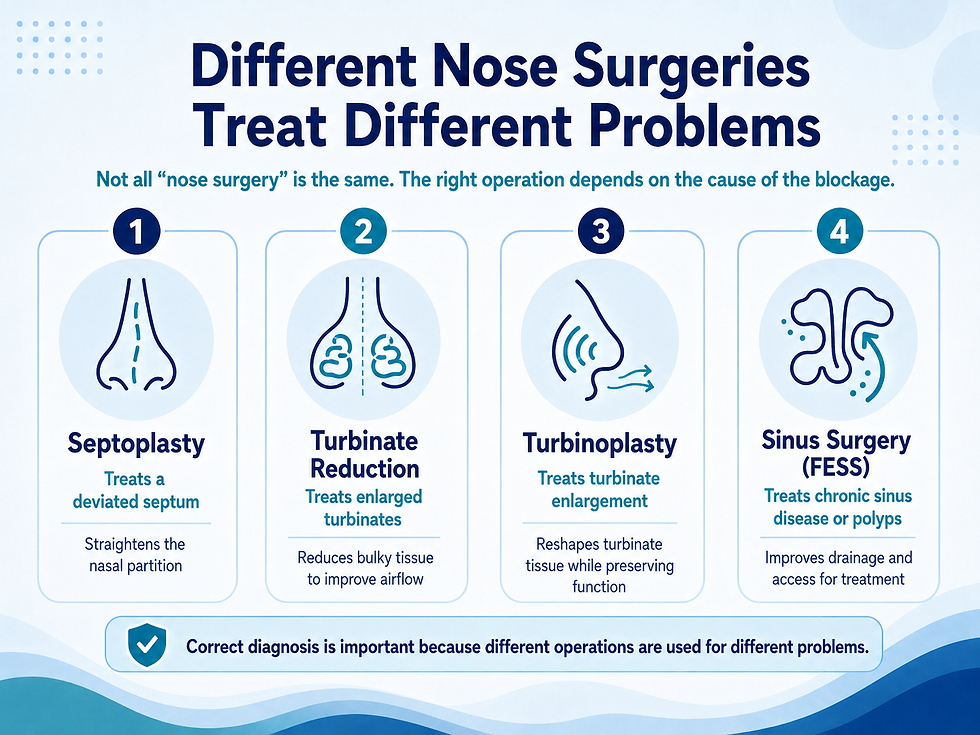
Endoscopic Sinus Surgery
Endoscopic sinus surgery, sometimes called FESS (Functional Endoscopic Sinus Surgery), is mainly performed for conditions such as:
chronic rhinosinusitis
recurrent sinus inflammation
nasal polyps
blocked sinus drainage pathways
certain fungal sinus diseases
The aim is to open the affected sinus pathways, improve drainage and ventilation, and allow medications such as nasal steroid sprays or rinses to reach the sinus cavities more effectively.
Septoplasty
A septoplasty corrects a deviated nasal septum. The septum is the wall separating the left and right nasal passages. If it is significantly bent, one side of the nose may be persistently narrow. Septoplasty corrects this structural obstruction.
Turbinate Reduction or Turbinoplasty
The inferior turbinates are normal structures along the side walls of the nose.
They help warm, humidify and filter the air that we breathe.
However, they can become excessively enlarged and contribute to nasal blockage.
Different operations may be used to reduce their volume, including:
radiofrequency turbinate reduction
submucosal turbinate reduction
turbinoplasty
partial turbinectomy
Modern turbinate surgery generally aims to improve airflow while preserving as much healthy turbinate function as possible.
Can Sinusitis Come Back After Sinus Surgery?
Yes.
This is particularly important for people with chronic rhinosinusitis.
Chronic rhinosinusitis is not simply a collection of “blocked sinuses” that can be permanently removed by an operation.
For many patients, it is a chronic inflammatory disease of the lining of the nose and sinuses.
Surgery improves the anatomy and drainage of the sinus cavities, but the tendency towards inflammation may remain.
This is why some patients may again develop symptoms such as:
nasal blockage
thick nasal mucus
postnasal drip
facial pressure
reduced sense of smell
recurrent sinus infections
...months or even years after sinus surgery.
Importantly, long-term studies also show that many patients continue to experience meaningful improvement after endoscopic sinus surgery even though a proportion will eventually require further treatment or revision surgery.
Large studies have reported long-term revision surgery rates in the region of approximately 15–20%, although the risk varies considerably according to the type and severity of sinus disease.
Patients with nasal polyps, asthma and certain inflammatory conditions generally have a higher risk of recurrence.
So: Recurrence is possible, but recurrence does not happen to everyone, and recurrence does not mean that sinus surgery provides no long-term benefit.
Blocked Nose After Surgery: Common Causes

Nasal Polyps Are Particularly Prone to Recurrence
Nasal polyps deserve special mention.
If a patient has chronic rhinosinusitis with nasal polyps, removing the polyps does not necessarily remove the biological tendency that caused them to form.
The underlying inflammation may continue.
Over time, new polyps can therefore develop.
One 12-year follow-up study found a high rate of polyp recurrence, although patients still had significantly better symptoms compared with before surgery, and only some required additional surgery.
The risk is particularly increased in patients with conditions such as:
asthma
aspirin-exacerbated respiratory disease (AERD)
severe eosinophilic inflammation
allergic fungal rhinosinusitis
recurrent nasal polyposis
This is why nasal polyp surgery is often better viewed as part of long-term disease control, rather than as a one-time cure.
Can Turbinates Grow Back After Turbinate Reduction?
This is another very common question.
The answer is slightly more complicated than simply saying that the turbinate “grows back”.
During most modern turbinate procedures, the entire turbinate should not be removed.
Instead, excess tissue is reduced while useful turbinate mucosa is preserved.
The remaining turbinate tissue is therefore still living nasal tissue.
It can swell again later.
For example, a patient may initially breathe extremely well after turbinoplasty but later experience congestion again because of:
allergic rhinitis
recurrent nasal inflammation
viral infections
exposure to dust or irritants
smoking
hormonal changes
chronic rhinitis
excessive use of topical nasal decongestant sprays
So when patients say:
“My turbinate grew back.”
what has happened may actually be recurrent swelling or hypertrophy of the remaining turbinate tissue, rather than the surgically removed portion literally regenerating back exactly as before.
Why Can the Nose Become Blocked Again After Turbinoplasty?
Imagine the inferior turbinate as a sponge covered with nasal lining.
Its size naturally changes.
When the blood vessels inside it become congested, it becomes larger. When they decongest, it becomes smaller.
A successful turbinoplasty creates more room inside the nasal passage.
But surgery cannot permanently switch off every future episode of inflammation.
If a patient continues to have significant allergic rhinitis, for example, the remaining turbinate mucosa may continue responding to allergens.
That person may therefore need ongoing treatment such as:
nasal steroid sprays
saline irrigation
antihistamines when appropriate
allergy management
avoidance of relevant irritants
even after successful surgery.
Can a Deviated Septum Come Back After Septoplasty?
In most adults, a properly corrected nasal septum does not simply grow back into its previous shape.
However, nasal obstruction can recur after septoplasty.
There are several possible reasons.
1. Residual septal deviation
The nasal septum is three-dimensional and can contain several areas of deviation.
Occasionally, a difficult deviation — particularly near the front, bottom or upper part of the septum — may remain.
2. Turbinate enlargement
Correcting the septum does not prevent the turbinates from swelling in the future.
A patient may therefore have a reasonably straight septum but still feel congested because of turbinate hypertrophy.
3. Allergic or non-allergic rhinitis
Septoplasty corrects anatomy.
It does not cure nasal allergy. Someone who has sneezing, watery rhinorrhoea and swollen nasal lining from allergic rhinitis may continue to experience nasal congestion despite having a straight septum.
4. Scar tissue or adhesions
Occasionally, scar tissue called synechiae can develop between surfaces inside the nose and narrow the airway.
5. Nasal valve obstruction
The narrowest portion of the nasal airway is called the nasal valve.
Some patients have nasal valve narrowing or collapse in addition to septal deviation.
If this component was not recognised initially, blockage may persist despite septoplasty.
Studies examining patients requiring revision septoplasty have identified residual structural abnormalities, turbinate hypertrophy, nasal valve problems and postoperative adhesions among the possible causes of persistent or recurrent obstruction.
Why Is My Nose Still Blocked Months After Septoplasty?
Timing matters.
A nose that feels blocked two weeks after surgery is very different from a nose that becomes blocked again two years later.
During the early healing period, nasal obstruction may occur because of:
swelling
crusting
dried blood
thick mucus
healing tissue
Therefore, the final result of nasal surgery should not normally be judged immediately after the operation.
If significant obstruction persists several months later, the cause should be reassessed rather than simply assuming that the operation has failed.
Why Do Some People Feel Great Initially, Then Become Blocked Again Years Later?
This is probably the source of many stories about nose surgery “not lasting”.
Several things may change with time.
A patient may develop:
worsening allergic rhinitis
recurrent turbinate hypertrophy
new nasal polyps
chronic sinus inflammation
scar tissue
nasal valve narrowing
new environmental exposures
repeated infections
The original surgery may still have successfully corrected the problem it was designed to treat.
A new or continuing inflammatory problem may now be contributing to the symptoms.
Surgery Corrects Anatomy : It Does Not Remove Every Cause of Nasal Blockage
This is probably the most important concept for patients to understand.
Consider someone who has:
Deviated septum + enlarged turbinates + allergic rhinitis.
Septoplasty can correct the deviated septum.
Turbinoplasty can reduce the enlarged turbinates.
But neither procedure changes the person's immune system so that he or she can never have allergic rhinitis again.
Likewise:
Endoscopic sinus surgery can open blocked sinus pathways, but it does not necessarily cure
the underlying inflammatory tendency of chronic rhinosinusitis.
This is why correct diagnosis before surgery is so important.
Does This Mean Nose Surgery Is Not Worth Doing?
No. The possibility of recurrence should not be interpreted to mean that surgery is useless.
The better question is:
“Was there an appropriate reason for surgery, and is surgery likely to improve the problem that is causing my symptoms?”
For appropriately selected patients, long-term outcomes can be very good.
A recent systematic review involving more than 4,000 patients found significant long-term improvement after septoplasty with or without turbinate surgery. Around three-quarters of patients reported satisfaction or improvement at long-term follow-up.
Likewise, long-term studies of endoscopic sinus surgery have shown sustained improvement in quality of life for many patients, even though some eventually require revision treatment.

Why Do We Hear More About Bad Experiences?
There is also an understandable human factor.
Someone who had surgery ten years ago, breathes normally and rarely thinks about their nose is unlikely to repeatedly tell friends:
“By the way, my septoplasty is still working perfectly.”
Someone who remains blocked after surgery, however, understandably remembers the experience and talks about it.
Both experiences are real.
But an individual friend's outcome cannot tell us whether surgery is appropriate for another patient with a completely different nasal problem.
Before Surgery, We Need to Know What Is Actually Causing the Blockage
A patient who says:
“My nose is blocked.”
may have one problem — or several problems occurring together.
Possible causes include:
deviated nasal septum
inferior turbinate hypertrophy
allergic rhinitis
non-allergic rhinitis
nasal polyps
chronic rhinosinusitis
nasal valve narrowing
adenoid enlargement
scar tissue
less commonly, a nasal mass or tumour
This is why examining the nose properly is important.
A nasal endoscopy allows an ENT specialist to look beyond the nostril and assess areas that cannot be adequately seen from the outside.
Depending on the symptoms and findings, a CT scan of the sinuses may also be required.
Can Surgery Prevent Nasal Blockage From Ever Happening Again?
No operation can realistically guarantee:
“You will never have a blocked nose again for the rest of your life.”
Even a person who has never undergone nasal surgery occasionally develops congestion during a cold.
The goal of surgery is therefore not to make the nose biologically incapable of swelling.
The goal is to correct a significant structural or sinus problem so that nasal breathing, sinus function and quality of life improve.
How Can We Reduce the Chance of Symptoms Returning?
Long-term treatment does not always end when the operation finishes.
Depending on the underlying condition, postoperative management may include:
Saline nasal irrigation
This helps remove crusts, mucus and inflammatory material, particularly following sinus surgery.
Nasal steroid treatment
Patients with allergic rhinitis, chronic rhinosinusitis or nasal polyps may require long-term topical anti-inflammatory treatment.
For patients with recurrent nasal polyps, adherence to postoperative topical steroid therapy has also been associated with lower recurrence risk.
Allergy management
If allergy is a major driver of turbinate swelling, controlling the allergy remains important after surgery.
Avoiding cigarette smoke and irritants
These can cause persistent inflammation of the nasal lining.
Regular follow-up
After sinus surgery, postoperative endoscopic examination and cleaning may be important during healing.
Longer-term review is particularly useful for patients with recurrent polyps or more severe inflammatory sinus disease.
Nose Still Blocked After Surgery? Do Not Immediately Assume You Need Another Operation
If your nose becomes blocked again months or years after:
sinus surgery
septoplasty
turbinate reduction
turbinoplasty
the first step should usually be to find out why.
A repeat nasal endoscopy may show that the previous surgical opening is actually still good.
The current problem may instead be:
swollen turbinates
nasal allergy
mucus
recurrent polyps
inflammation
adhesions
septal deviation
nasal valve obstruction
Some of these problems can be treated medically.
Revision surgery is only appropriate when there is a structural or disease-related reason for it.
Frequently Asked Questions
Can sinusitis come back after surgery?
Yes. Chronic rhinosinusitis is often an inflammatory condition, so inflammation can recur even after successful endoscopic sinus surgery. Surgery improves sinus drainage and access for treatment but does not necessarily eliminate the underlying tendency towards inflammation.
Can you get sinusitis again after sinus surgery?
Yes. Patients can still develop viral infections, acute sinus infections or recurrence of chronic sinus inflammation after surgery. However, many patients continue to have significantly better long-term symptoms than before surgery.
Can nasal polyps grow back after sinus surgery?
Yes. Nasal polyps can recur because surgery removes existing polyps but does not completely remove the inflammatory tendency that produces them. Recurrence is more common in certain patients, particularly those with asthma, AERD or severe inflammatory disease.
Can turbinates grow back after reduction surgery?
Remaining turbinate tissue can enlarge or swell again. This is often described as the turbinate “growing back”, although recurrent mucosal swelling or hypertrophy is usually a more accurate description.
How fast can turbinates grow back?
There is no single timetable. Recurrent enlargement depends on factors such as allergy, chronic rhinitis, environmental exposure and the type of turbinate procedure performed. Symptoms may recur months or years later in some patients.
Why is my nose still blocked months after turbinate reduction?
Possible causes include persistent swelling, allergic rhinitis, crusting during healing, residual turbinate hypertrophy, septal deviation, nasal valve problems or other nasal disease. Nasal examination or endoscopy can help determine the cause.
Can a deviated septum come back after septoplasty?
The corrected septum generally does not simply “grow back”. However, residual or recurrent deviation can occur, and nasal obstruction may also develop from other causes such as turbinate swelling, scar tissue or nasal valve narrowing.
Why is my nose still blocked even after septoplasty?
A straight septum is only one part of the nasal airway. Turbinate hypertrophy, allergic rhinitis, nasal valve narrowing, adhesions or residual areas of septal deviation may also cause obstruction.
How long does congestion last after septoplasty or turbinate surgery?
Some congestion is expected during the first few weeks because of postoperative swelling, crusts and mucus. Healing continues gradually. Persistent obstruction several months after surgery deserves reassessment.
Are septoplasty results permanent?
The structural correction is intended to be long lasting. Studies generally show significant improvement in nasal obstruction at long-term follow-up, although some patients experience recurrent symptoms over time.
Is turbinate reduction permanent?
It can provide long-lasting improvement, but the remaining turbinate tissue continues to respond normally to inflammation, allergy and environmental triggers. Therefore, congestion can recur.
How many years does sinus surgery last?
Sinus surgery does not have a fixed “expiry date”. Many patients have durable improvement for many years. Because chronic rhinosinusitis is an inflammatory disease, some patients may experience recurrence or eventually require further treatment.
Is turbinate surgery worth it?
For appropriately selected patients with significant turbinate hypertrophy that has not responded adequately to medical treatment, turbinate surgery can substantially improve nasal airflow. The benefits and risks depend on the technique used and the underlying cause of obstruction.
What should I expect three months after sinus surgery?
By this stage, most early postoperative swelling and crusting should have substantially improved. Some patients with chronic inflammatory sinus disease may still require nasal rinses, steroid sprays or other maintenance treatment.
When should I see an ENT again after previous nose surgery?
Consider reassessment if you develop persistent or worsening nasal blockage, recurrent sinus infections, reduced smell, recurrent polyps, one-sided obstruction, repeated bleeding or symptoms that interfere with sleep and daily activities.
The Bottom Line
Yes, nasal blockage, sinus symptoms and turbinate swelling can recur months or years after nose surgery.
But the explanation is rarely as simple as:
“The surgery wore off.”
Septoplasty treats a deviated septum.
Turbinoplasty treats enlarged turbinates.
Endoscopic sinus surgery treats blocked or diseased sinus pathways.
None of these operations can permanently prevent every future episode of allergy, inflammation, infection or nasal swelling.
The most important part of successful treatment is therefore identifying the correct cause of the patient's symptoms before surgery and continuing appropriate treatment afterwards when the underlying disease requires it.
If you have previously undergone nasal or sinus surgery and your nose has become blocked again, a nasal endoscopic examination can often clarify whether the problem is recurrent inflammation, turbinate swelling, polyps, scar tissue, septal deviation or another cause.
A blocked nose after previous surgery does not automatically mean that the original operation failed — and it does not automatically mean that another operation is required.
References
Smith KA, et al. Long-term revision rates for endoscopic sinus surgery. International Forum of Allergy & Rhinology. 2019. https://pubmed.ncbi.nlm.nih.gov/30570840/
DeConde AS, et al. Long-term outcomes of endoscopic sinus surgery in the management of adult chronic rhinosinusitis. International Forum of Allergy & Rhinology. 2019. https://pubmed.ncbi.nlm.nih.gov/31207172/
van der Veen J, et al. Twelve-year follow-up study after endoscopic sinus surgery in patients with chronic rhinosinusitis with nasal polyposis. 2019. https://pubmed.ncbi.nlm.nih.gov/31249662/
Long-Term Outcomes of Septoplasty With or Without Turbinoplasty: A Systematic Review. Laryngoscope. 2024. https://pubmed.ncbi.nlm.nih.gov/37991145/
