Why Are My Ears Always Itchy? Causes of Chronic Ear Itching

Updated: Aug 20

Why does my ear feel so itchy inside, even when the doctor says my ear looks normal?
This is a very common complaint in my ENT clinic. Some patients experience chronic ear itching for months or even years. The itch may feel deep inside the ear canal and, in some people, may seem particularly troublesome at night.
They may repeatedly clean their ears with cotton buds, ear picks or other tools because they assume there must be earwax, fungus or an infection inside.
However, during examination, I frequently find that the ear canal and eardrum actually look quite normal.
So why do your ears itch, and what is the safest ear itching treatment?

What Causes Chronic Ear Itching?
The ear canal is covered by very thin and sensitive skin.
Earwax, or cerumen, forms part of the ear's natural protection. It helps lubricate the ear canal and protects its delicate skin.
Chronic itching may occur because of:
dry ear canal skin
excessive ear cleaning
eczema or dermatitis
contact allergy or irritation
earphones or hearing aids
moisture inside the ear
fungal infection
bacterial otitis externa
excessive or impacted earwax
Importantly, an itchy ear does not automatically mean that there is an ear infection. Sometimes there may be very little abnormality to see during an ENT examination.

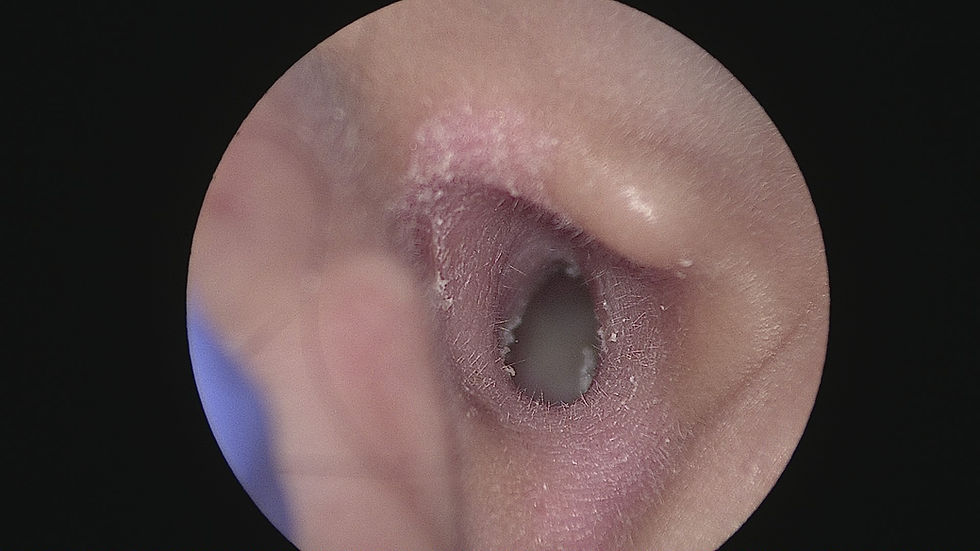


1. Dry Skin Inside the Ear Canal
One of the common reasons for persistent ear itching is dry or sensitive ear canal skin.
Some people naturally produce relatively little earwax.
Others repeatedly remove their earwax because they feel that an ear should always be completely clean.
But earwax is not simply dirt.
Removing too much of it may leave the ear canal dry and irritated.
A common cycle develops:
Ear becomes itchy → you clean or scratch it → the skin becomes irritated → it becomes even itchier → you clean it again.
This is sometimes called the itch–scratch cycle.
Breaking this cycle can be more helpful than repeatedly putting medication into an otherwise healthy ear.

Repeated scratching, cotton bud use or ear picking can damage the delicate ear canal skin and create an itch–scratch cycle. Breaking the cycle often starts by avoiding further irritation and treating the underlying cause.

2. Cleaning Your Ears Too Often
Many people use cotton buds after every shower. Others regularly use metal ear picks or specialised ear-cleaning tools.
Unfortunately, repeated rubbing can cause microscopic trauma to the delicate ear canal skin.
It can also remove the protective layer of earwax.
Therefore, excessive cleaning itself can become the reason why your ears keep itching.
For most healthy ears:
You do not need to routinely clean deep inside the ear canal.
The ear normally has a self-cleaning mechanism that gradually moves old earwax towards the opening of the ear.
3. Ear Eczema and Dermatitis
Just like other parts of the body, the skin inside and around the ear can develop inflammation.
Possible conditions include:
atopic eczema
seborrhoeic dermatitis
psoriasis
irritant dermatitis
allergic contact dermatitis
Some patients have obvious redness, flaking or scaling.
In mild cases, however, the changes can be very subtle and the ear canal may appear almost normal.
Patients who have dandruff, eczema or seborrhoeic dermatitis around the scalp, eyebrows or face may also develop similar skin irritation around the ears.
Ear Itching Outside the Ear:
When ear itching occurs outside the ear canal, particularly around the ear opening, behind the ear or around the earlobe, skin conditions become even more important to consider. Eczema, psoriasis, hair products, earrings and allergic reactions may all contribute.

4. Allergies and Contact Irritation
Products that regularly touch the ear can sometimes cause irritation or allergic contact dermatitis.
Possible triggers include:
earbuds
headphones
hearing aids
earrings
hair dye
shampoo
hair products
cosmetics
topical antibiotic preparations
certain ear drops
If your ears become itchy after using a particular product, consider whether it could be contributing.
Occasionally, patients repeatedly use different ear itching medicines in an attempt to stop the itch, only to find that the medication itself further irritates the skin.
5. Earphones and Earbuds
Earbuds are now worn for several hours a day by many people.
Prolonged use may:
trap heat and moisture
rub against the ear canal entrance
irritate sensitive skin
introduce debris or skin products
cause contact allergy in susceptible individuals
If your symptoms become noticeably worse after wearing earbuds, try reducing their use for a period of time.
Reusable earbuds should also be cleaned regularly.
6. Water and Moisture in the Ear
Water entering the ear during swimming, showering or frequent washing may irritate the ear canal.
A persistently moist environment also increases the risk of bacterial or fungal otitis externa.
Why Do My Ears Feel Wet Inside and Itchy?
A wet and itchy ear can have several explanations. Sometimes it is simply retained water or increased moisture. However, if the ear genuinely feels wet repeatedly, especially when accompanied by discharge, smell, pain or blocked hearing, an infection or inflammatory ear condition should be considered.
An ENT examination can help determine whether there is actual discharge or whether the sensation is occurring despite a relatively normal ear canal.
7. Fungal Ear Infection
A fungal infection of the external ear canal is known as otomycosis.
Itching is one of its common symptoms.
Otomycosis is particularly relevant in warm and humid countries such as Malaysia.
However:
Not every itchy ear is caused by fungus.
A fungal ear infection usually produces abnormalities that can be seen during examination, such as:
fungal spores or debris
wet material
discharge
redness
inflammation of the ear canal
Repeatedly using antifungal ear drops without confirming the diagnosis is therefore not advisable.

How Do I Tell If an Ear Infection Is Bacterial or Fungal?
Patients often ask whether they can tell the difference themselves.
Unfortunately, symptoms frequently overlap.
Bacterial otitis externa may cause:
increasing ear pain
tenderness when touching or pulling the ear
redness and swelling
discharge
blocked hearing
Fungal otitis externa may cause:
prominent itching
fullness or blockage
discharge
visible fungal debris
sometimes milder pain
However, symptoms alone cannot reliably distinguish the two. Looking directly into the ear canal is usually much more useful than guessing based on symptoms.
What Are the First Signs of an Ear Infection?
Early external ear infection may initially produce:
itching
mild discomfort
ear fullness
tenderness
increasing moisture or discharge
As inflammation progresses, pain and swelling usually become more obvious.
If the ear becomes painful rather than simply itchy, an infection becomes more important to rule out.
What Can Be Mistaken for an Ear Infection?
Several conditions may produce ear discomfort or itching without a bacterial infection.
These include:
ear canal eczema
seborrhoeic dermatitis
psoriasis
fungal infection
contact dermatitis
impacted earwax
dry ear canal skin
irritation caused by cotton buds
irritation from hearing aids or earbuds
This is one reason why antibiotic ear drops should not automatically be used for every itchy ear.
8. Earwax
Earwax can occasionally cause itching, especially if a large amount becomes impacted.
However, normal earwax is protective.
Many patients with chronic ear itching actually have very little earwax because they clean their ears too frequently.
Removing normal earwax unnecessarily may therefore worsen the problem rather than solve it.
My Ears Itch Deep Inside at Night — Why?
Some patients specifically notice that their ears itch deep inside at night.
This does not necessarily point towards a particular disease.
Itching may simply become more noticeable when you are lying quietly in bed with fewer distractions.
Dry skin, eczema, irritation and the itch–scratch cycle may all contribute.
However, persistent night-time itching accompanied by discharge, pain or hearing changes should still be examined.
What Deficiency Causes Itchy Ears?
There is no single vitamin or mineral deficiency that commonly explains an isolated chronic itchy ear.
Although certain nutritional deficiencies can affect the skin in general, persistent itching confined to the ear canal is much more commonly related to local skin irritation, dermatitis, moisture, ear cleaning or external ear disease.
Therefore, taking vitamins or supplements without identifying a deficiency is unlikely to solve most cases of chronic itchy ears.
How Do You Cure an Itchy Ear?
The correct treatment depends on the cause.
There is no single medicine that is appropriate for every itchy ear.
Treatment may involve:
stopping excessive ear cleaning
avoiding cotton buds and ear picks
keeping unnecessary water out of the ear
avoiding a suspected irritant or allergen
temporarily reducing earbud use
treating eczema or dermatitis
removing impacted earwax when necessary
treating confirmed bacterial infection
treating confirmed fungal infection
If the ear examination is completely normal, sometimes the most important treatment is simply to stop repeatedly disturbing the ear canal.
What Ear Itching Medicine Should I Use?
There is no universal ear itching medicine.
Depending on the diagnosis, a doctor may occasionally prescribe:
topical treatment for dermatitis or eczema
antibacterial ear drops
antifungal treatment
other preparations intended to soothe or protect inflamed skin
However, using antibiotic, antifungal or steroid-containing ear drops without knowing the cause is not recommended.
The condition of the eardrum is also important because not every ear preparation is suitable when an eardrum perforation is present.
What Home Remedy Can I Use for Itchy Ears?
For a mildly itchy ear that otherwise feels normal, the safest first step is often not to put anything into it.
Try:
stopping cotton buds and ear picks
avoiding scratching
reducing unnecessary water exposure
temporarily reducing earbud use if this seems to trigger symptoms
avoiding any newly introduced hair or skin product that may be irritating the ear
Avoid inserting unproven substances deep into the ear canal.
Home remedies can become problematic if there is an unknown eardrum perforation, active infection or dermatitis.
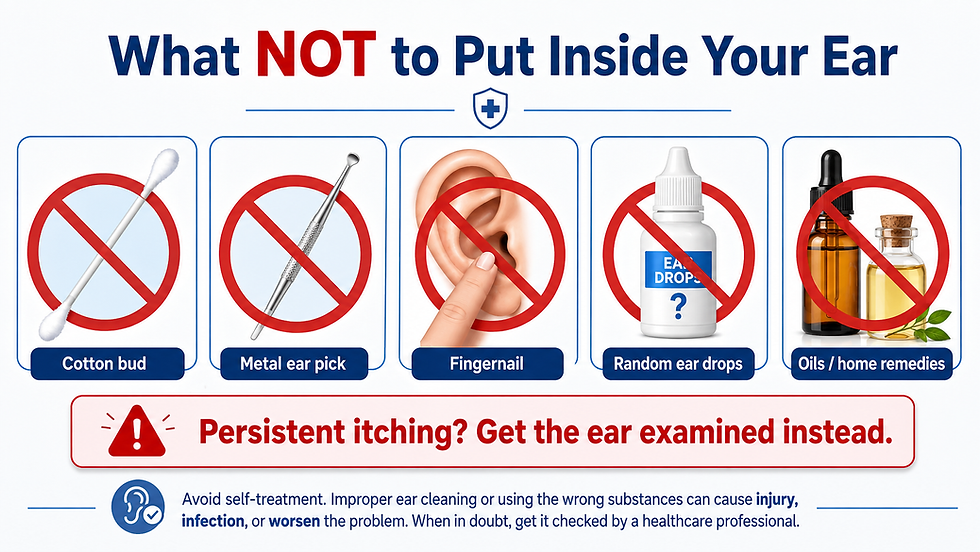
Do not put cotton buds, ear picks, fingernails, random ear drops, or oils into an itchy ear. Persistent itching should be properly examined, as self-treatment can worsen irritation, cause injury, or lead to infection.
What Kills Ear Fungus Naturally?
Many online sources recommend substances such as oils, vinegar or other homemade preparations for fungal ear infections.
However, if you genuinely have an ear fungus, I would recommend having the ear examined rather than experimenting with substances inside the ear.
Otomycosis frequently requires proper cleaning of fungal debris together with appropriate antifungal treatment.
Furthermore, putting liquid into an ear when the condition of the eardrum is unknown may not be safe.
Why Does Scratching an Itchy Ear Feel So Good?
Scratching temporarily interferes with the itching sensation, which is why it can feel satisfying.
Unfortunately, repeated scratching damages the skin barrier.
This causes further inflammation and produces even more itching.
Eventually, repeated ear picking can result in:
abrasions
bleeding
bacterial infection
fungal infection
swelling
painful otitis externa
So although scratching gives temporary relief, it can make the long-term problem considerably worse.
When Should I Worry About Itchy Ears?
An occasional mild itch is usually not concerning.
However, you should consider having your ear examined if the itching:
continues for several weeks
repeatedly comes back
affects mainly one ear
becomes increasingly severe
interferes with sleep
You should seek medical assessment particularly if there is:
ear pain
discharge
foul smell
bleeding
hearing loss
significant blocked sensation
swelling
visible abnormal skin
persistent wetness inside the ear
People with diabetes or reduced immunity should also be more cautious about persistent external ear symptoms.
Is Left or Right Ear Itching Supposed to Have a Meaning?
Internet searches sometimes include phrases such as “left ear itching female meaning,” “right ear itching female meaning” or “ear itching spiritual meaning.”
There are various traditional or cultural beliefs associated with these ideas.
However, from a medical perspective, there is no established scientific evidence that itching of the left or right ear predicts an event or has a particular spiritual meaning based on gender.
Persistent itching is much more likely to have a physical explanation involving the ear canal or surrounding skin.
The Most Important Advice: Stop Digging Your Ears
Many patients with chronic itchy ears become trapped in a cycle:
Itching → ear picking → skin irritation → more itching → more ear picking.
If an ENT examination shows no wax impaction, infection, fungal debris or significant skin disease, repeatedly cleaning the ear may actually be perpetuating the problem.
Sometimes your ears do not need another cotton bud. They simply need to be left alone.
When Should I See an ENT Doctor?
If your ears have been itching repeatedly for weeks or months, an ENT examination can determine whether there is:
impacted earwax
fungal infection
bacterial otitis externa
eczema or dermatitis
foreign material
inflammation
discharge
an abnormal eardrum
This allows ear itching treatment to be directed at the actual cause rather than repeatedly trying different remedies or ear drops.
Take-Home Message
Chronic ear itching does not necessarily mean that you have fungus, an infection or too much earwax.
When the ear appears normal, common contributing factors include:
sensitive or dry ear canal skin
excessive ear cleaning
repeated scratching
eczema or dermatitis
contact irritation
moisture
prolonged earbud use
The more aggressively an otherwise healthy ear is cleaned, the more irritated it may become.
If the itching persists, getting the ear properly examined is usually much more useful than continuing to scratch, clean or experiment with different ear drops.
References
Dermatitis of the Ear Canal (Chronic Otitis Externa). Merck Manual Professional Edition. Read more
Schwartz SR, et al. Clinical Practice Guideline (Update): Earwax (Cerumen Impaction). Otolaryngology–Head and Neck Surgery. 2017. PubMed
Munguia R, Daniel SJ. Ototopical antifungals and otomycosis: a review. International Journal of Pediatric Otorhinolaryngology. 2008. PubMed
Anwar K, Gohar MS. Otomycosis; clinical features, predisposing factors and treatment implications. Pakistan Journal of Medical Sciences. 2014. PubMed